
State and local government action is helping eliminate “one of the Trump regime’s key tactics for mass deportation and family separation,” one advocate said
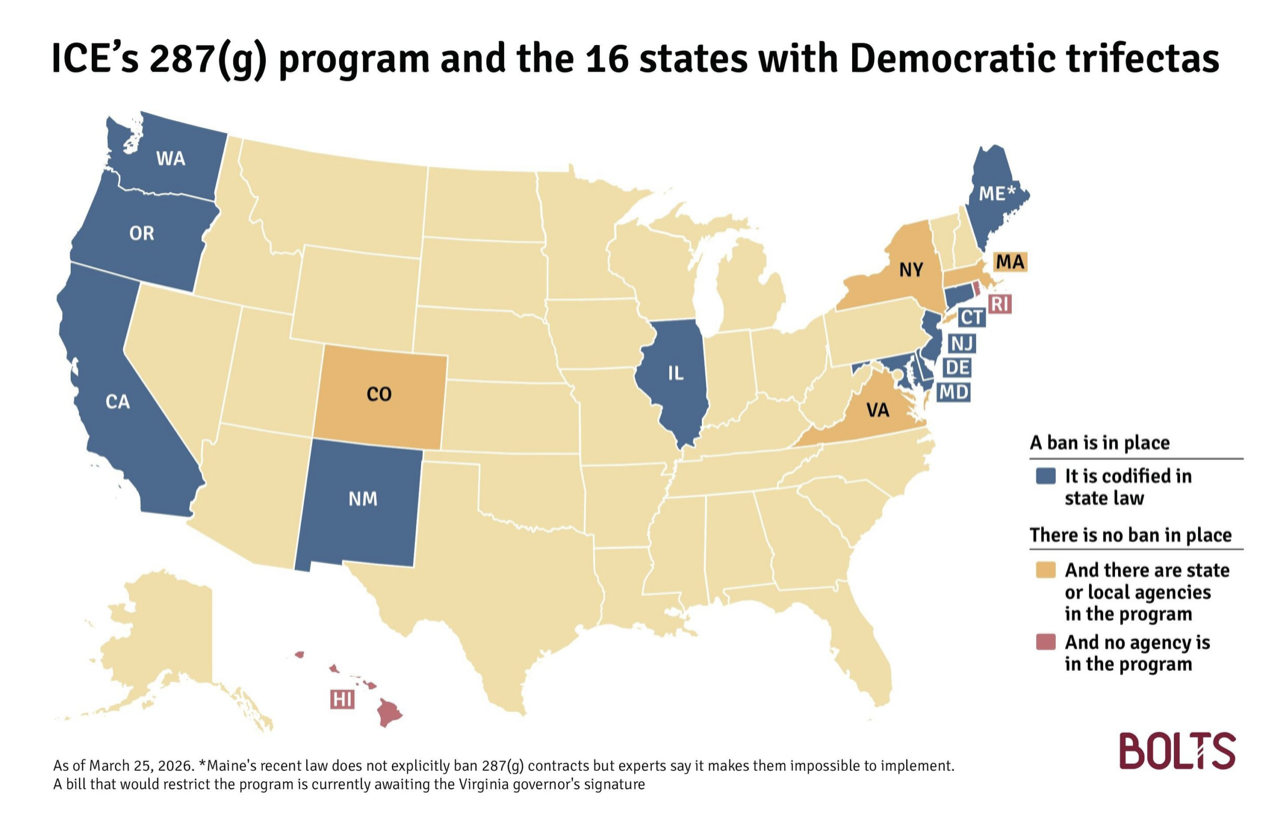
Local and state lawmakers all across the country have been taking substantive action to push back against the Trump administration’s brutal mass deportation efforts, in particular proposing and passing legislation to rein in deeply-flawed 287(g) agreements, a controversial federal policy that allows local law enforcement officers to be deputized as ICE agents and that has “exploded in popularity” under Trump’s second term, as Bolts reports.
RESTORING TRUST
In New Jersey, Gov. Mikie Sherrill’s signature late last month makes the state the 10th in the nation to ban 287(g) agreements, which experts have said make communities less safe by perpetuating racial profiling in addition to wasting local law enforcement resources. The Immigrant Trust Directive, which codifies a 2018 directive from then-Attorney General Gurbir Grewal, is notable for “eliminating one of the Trump regime’s key tactics for mass deportation and family separation,” said Make the Road New Jersey.
“Sherrill also signed two other pieces of legislation aimed at protecting New Jersey’s immigrants,” Bolts reports. “The Privacy Protection Act, which restricts when local and state agencies can collect information about immigration status or share it with the federal government; another law requires ICE agents to show their faces and provide identification before making an arrest.”
Make the Road New Jersey’s Nedia Morsy told Bolts that passage of the bills under new state leadership shows “the state legislature and the [Sherrill] administration is recognizing that there is rising authoritarianism and there is a need to act.”
STOPPING HARMFUL DETENTION
New Mexico also moved to ban 287(g) agreements, after Gov. Michelle Lujan Grisham signed into law a sweeping plan that also prohibits localities and the state government from entering into agreements to detain immigrants for civil immigration violations, as well as stops the use of public lands for immigration-related detention, a coalition of groups said.
They said the legislation makes the state a leader in “comprehensively” rejecting “involvement in a deportation system marked by violence, abuse, and death.”
“New Mexico’s three detention centers have facilitated this system of harm, with documented cases of excessive use of solitary confinement, inadequate medical care, lack of clean drinking water and food, and five deaths in custody in recent years,” the groups said following Gov. Lujan Grisham’s Feb. signature. “The Immigrant Safety Act ensures New Mexico will no longer be complicit in these abuses.”
The groups note the alarming rise in deaths in ICE custody, with one expert noting that deaths have been coming at the rate of one every six days.
ICE ACCOUNTABILITY
In Maryland, Gov. Wes Moore signed legislation banning the state’s 287(g) contracts amid “thunderous” chants of “Si, se puede,” or “Yes, we can,” Bolts reported in Feb. “In Maryland, we defend Constitutional rights and Constitutional policing—and we will not allow untrained, unqualified, and unaccountable ICE agents to deputize our law enforcement officers,” Gov. Moore said. “Maryland is a community of immigrants, and that’s one of our greatest strengths because this country is incomplete without each and every one of us.”
More local action to protect immigrant community members came from Maryland’s Montgomery County Council earlier that month, when members unanimously passed “landmark” legislation that largely blocks county employees from inquiring about immigration status, forbids discrimination or intimidation based on immigration status, and ensures country services are accessible to all regardless of legal status.
“As an immigrant who came to this country as a teenager and faced the threat of deportation, I know firsthand the fear many families live with,” said Council President Natali Fani-González. “Montgomery County is my home—a place where I’ve raised my family. Here, we believe in treating everyone with dignity, no matter where they were born, the color of their skin, who they love, or the language they speak. This bill reflects those values.”
PROTECTING FAMILIES
In Virginia, the commonwealth’s legislature has taken “aggressive” action to try to curb the federal government’s destructive mass deportation agenda, including sending to Gov. Abigail Spanberger’s desk a number of bills that would restrict 287(g) agreements, protect sensitive locations like courthouses and schools from raids, and largely ban law enforcement officers from wearing masks, VPM News reports. Those bills have not yet been signed or vetoed as of publishing date.
One local lawmaker said in an op-ed at The Virginian-Pilot that the bills are a reflection of the uncertainty and alarm families are feeling all over the commonwealth.
“Every single day, I hear from families in my district who are terrified: parents afraid to drop their kids at school for fear of being taken; job sites vacant as workers refuse to come to work out of fear of unlawful deportation; kids going hungry because the community centers and libraries where churches hand out food are now ICE targets; and crime victims afraid to call the police,” wrote Delegate Dan Helmer. “This fear does not make communities safer. It makes everyone more vulnerable.”
OTHER LOCAL COMMUNITIES ARE ALSO ACTING
In Pennsylvania, the Pittsburgh City Council this week unanimously passed a bill codifying Mayor Corey O’Connor’s position “that no city government employees may ask about a person’s immigration or citizenship status, or cooperate with federal immigration agents,” USA Today reports. In Texas, the Houston City Council approved an ordinance that “will prohibit officers from detaining people or prolonging traffic stops due to civil immigration warrants,” Houston Public Media reported. “It will also require regular reports from Mayor John Whitmire’s administration on local immigration enforcement.” And in California, the Pasadena City Council “directed the drafting of an ordinance to codify local limits on the use of city-owned property by Immigration and Customs Enforcement agents,” the Pasadena Star-News reports. Click here for a deeper-dive into how communities all across the country are acting to protect their immigrant neighbors.
