
Evelio Menjivar-Ayala, currently auxiliary bishop in the archdiocese of Washington D.C., has urged Americans to stand up for their immigrant neighbors
Pope Leo XIV’s pick to lead West Virginia Catholics is a prelate who was at one time an undocumented immigrant. Evelio Menjivar-Ayala, who has served as an auxiliary bishop in the archdiocese of Washington D.C. since 2023 and has now been selected by the pontiff to become the new bishop of West Virginia, is a Central American immigrant who fled for his life hidden in the trunk of a car, The Guardian reports.
“Born on 14 August 1970, in Chalatenango, El Salvador, Menjivar-Ayala’s journey to the priesthood began in the violence of the Salvadorian civil war, where he and his family narrowly survived being fired upon by soldiers while fleeing their home, he previously told the Catholic Standard,” The Guardian said. “After two failed attempts to reach the US, hindered by deportation and a guide who deserted the migrant group, he finally succeeded on his third try, despite a brief imprisonment in Mexico and a grueling desert crossing.”
Menjivar-Ayala, who arrived in the U.S. with just an extra set of clothes as his only possessions, worked a series of essential jobs in construction and janitorial services while earning his GED before entering the priesthood, The Guardian noted.
During a press event announcing his elevation to bishop of West Virginia, Menjivar-Ayala pledged to stand by working people, including immigrants. Menjivar-Ayala has already asserted fierce support for immigrant communities as Washington’s auxiliary bishop, including penning an April 2025 National Catholic Reporter op-ed that rebuked the federal government’s mass deportation agenda and urged faithful to not be complicit in the targeting of their neighbors.
“To those of you who are silent or think this does not involve you, to those of you who are not troubled by this — or worse, who applaud it — particularly those who are Catholic, I ask you: Do you not see the suffering of your neighbors?” he wrote. “Do you not realize the pain and misery and very real fear and anxiety these unjust government operations and policies are causing? Is your conscience not disturbed? How can you stay quiet? In the final teaching of his public ministry, Jesus warned that we will be judged on how we respond to others in distress (Mt 25:41-46).”
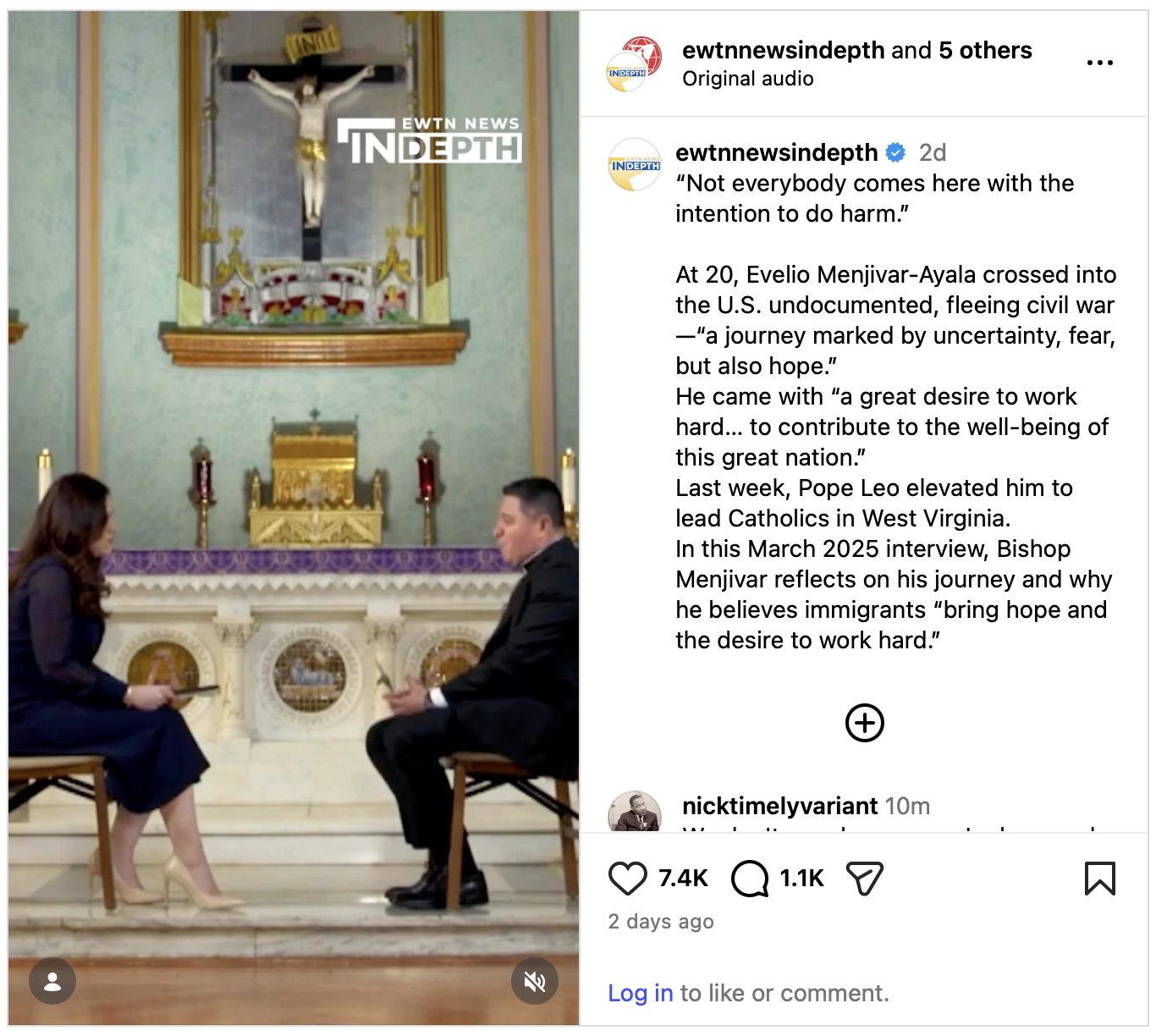
Menjivar-Ayala’s elevation to bishop of West Virginia is a continued affirmation of the pro-immigrant legacy established by the late Pope Francis and continued on under his successor’s term. In November, Pope Leo condemned the U.S. government’s mistreatment of immigrants, saying that “when people have lived good lives—many of them for 10, 15, 20 years—treating them in a way that is, to say the least, extremely disrespectful, and with instances of violence, is troubling.”
The remark, one of several pro-immigrant statements from the pontiff that fall, came after a rare, nearly-unanimous “Special Message” from the U.S. Conference of Catholic Bishops lamenting the “vilification” of immigrants.
“We are concerned about the conditions in detention centers and the lack of access to pastoral care,” bishops wrote. “We lament that some immigrants in the United States have arbitrarily lost their legal status. We are troubled by threats against the sanctity of houses of worship and the special nature of hospitals and schools. We are grieved when we meet parents who fear being detained when taking their children to school and when we try to console family members who have already been separated from their loved ones.”
“Leo, who has previously urged local bishops to take the lead on speaking out on matters of social justice, said he appreciated the U.S. bishops’ statement and urged Catholics and all people of goodwill to listen to what they said,” National Catholic Reporter noted.
In his April 2025 op-ed at the National Catholic Reporter, Menjivar-Ayala urged everyday people to rally their courage by noting the example of the late Óscar Romero, who served as auxiliary bishop of the Archdiocese of San Salvador until his assassination in March 1980. Commonly referred to as “‘bishop of the poor’ for his work defending the Salvadoran people,” Romero was murdered “after calling for international intervention to protect those being killed by government forces,” as U.S. Catholic notes.
“When I was growing up in El Salvador, there was a man who was not afraid to speak out,” Menjivar-Ayala wrote. “His name was Óscar Romero, archbishop of San Salvador. It seems to me that we need more Óscar Romeros today. We need everyone of good will to follow his lead and demand that the government respect human dignity.”
Menjivar-Ayala also issued a call to federal officers urging them to “reclaim your conscience. What you are doing is worth nothing if it is stained with unjust cruelty,” he continued. “That is not what America stands for. You too can and should speak out against this terror and infliction of suffering on people. You can refuse to be involved in oppression and these grievous assaults on human rights and dignity.”
